Back to menu


Poland and Sweden offer growing business opportunities for international companies developing dual-use technologies for defence, security and critical infrastructure. But entering these markets requires more than an innovative product. Finding the right local partners, understanding defence procurement and identifying potential customers are essential to building a successful market-entry strategy.
Europe’s increased focus on defence capabilities, security and resilience is creating opportunities for technologies originally developed for commercial applications.
Artificial intelligence, cybersecurity, drones, robotics, secure communications, satellite technologies and advanced manufacturing are increasingly relevant to both civilian and defence markets.
However, companies looking to enter the Polish or Swedish dual-use market face several practical questions.
Who are the potential customers? How does defence procurement work? Should the company look for a distributor, systems integrator or manufacturing partner? And how can it establish the relationships needed to secure its first contracts?
These are among the issues we address in our contribution to Financing Dual-Use Innovation: Polish–Swedish Opportunities in Defence, Security and Space.
At Explore Markets, we contributed the market-entry and partner-search perspective, drawing on our experience supporting international companies entering Poland, Sweden, the Nordics and Central and Eastern Europe.
Our central recommendation is simple: the right local partner can determine whether a promising technology becomes a commercial opportunity.
Dual-use market opportunities in Poland and Sweden
Dual-use technologies are products, services or solutions that can have both civilian and defence or security applications.
For companies developing solutions in AI, cybersecurity, communications, autonomous systems and advanced manufacturing, this creates opportunities to expand beyond traditional commercial customers.
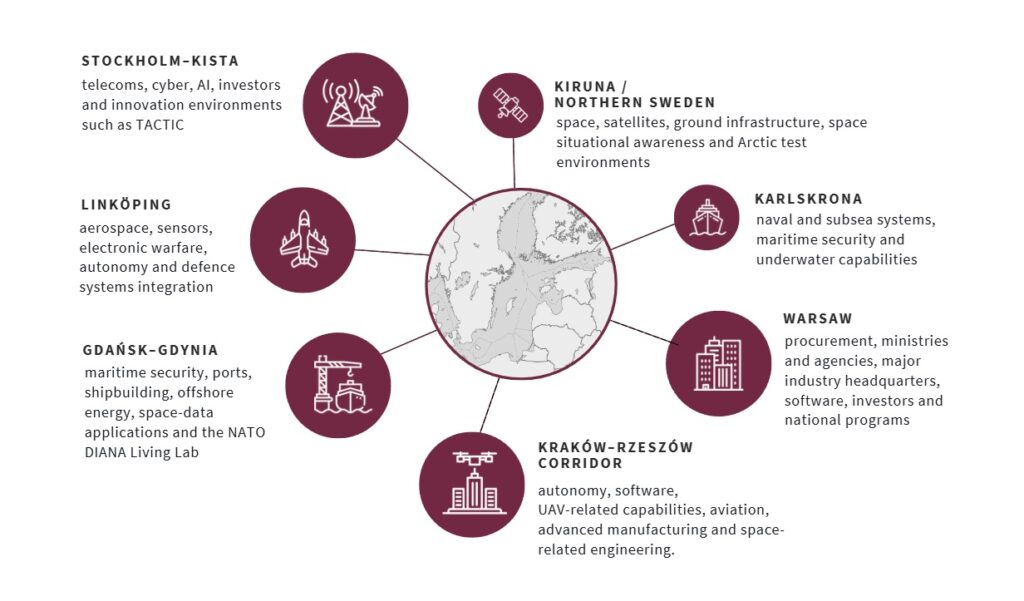
Poland and Sweden are particularly interesting because they offer complementary strengths.
Poland combines significant defence investment, demand for new capabilities and opportunities for industrial localisation.
Sweden offers an established defence and technology ecosystem, advanced systems integration capabilities and access to international supply chains.
Both markets can offer opportunities for international technology companies, but the route to market can differ considerably.
Understanding those differences is an important part of preparing a market-entry strategy.
Defence market entry in Poland: Opportunities for technology suppliers and industrial partners
Poland has become an increasingly important European market for defence and security technologies.
The country’s defence investment and ambitions to expand domestic industrial capacity are creating opportunities for international suppliers of advanced technologies, equipment, components and specialist services.
Relevant sectors include:
- Drones, counter-UAS and autonomous systems
- Sensors, surveillance and secure communications
- Cybersecurity and artificial intelligence
- Critical-infrastructure protection
- Space and satellite technologies
- Advanced manufacturing and industrial components
- Maintenance and lifecycle-support services
However, entering the Polish defence market is not always a straightforward export or distribution project.
For many technologies, especially those requiring integration into larger systems, international companies may need a local industrial or technical partner.
Finding defence partners and suppliers in Poland
Depending on the technology and intended customer, relevant partners may include:
- Systems integrators capable of incorporating a technology into larger defence or security systems.
- Polish manufacturers offering local production, assembly or component supply.
- Prime contractors involved in larger defence procurement projects.
- Engineering and technology companies contributing specialised expertise.
- Service and maintenance providers supporting installation, technical servicing and lifecycle requirements.
- Industrial partners capable of jointly participating in procurement projects.
Our experience in international B2B partner searches shows why defining the partner’s role is essential.
A company supplying specialised sensors, for example, may find a more effective route to the Polish market by working with a systems integrator than by seeking a traditional distributor.
Similarly, a supplier of advanced industrial components may need to identify relevant manufacturers or prime contractors rather than approach defence end users directly.
Successful partner identification starts with understanding what the partner needs to do, not simply which companies operate in the sector.
Why localisation matters in the Polish defence market
For international technology providers, localisation may become an important part of the commercial proposition.
Local manufacturing, assembly, technical integration or maintenance capabilities can support cooperation with Polish industrial partners and help address customer requirements.
This does not mean every foreign company must establish production in Poland.
It means that companies should assess whether local industrial cooperation could strengthen their route to market.
In some cases, a suitable local partner can provide the manufacturing capacity, technical expertise or customer relationships needed to move a project forward.
For this reason, supplier searches and industrial partner identification should be considered early in a Polish market-entry strategy.
Defence and dual-use market entry in Sweden: Validation, integration and export
Sweden offers a different environment for international dual-use and defence technology companies.
Its market includes established defence system companies, specialised technology SMEs, research organisations, public procurement structures and internationally active industrial supply chains.
For companies entering the Swedish defence market, opportunities may be found through:
- Defence industry suppliers and prime contractors
- Systems integrators
- Technology and engineering partners
- Research and testing environments
- Innovation and validation programmes
- FMV and relevant public procurement structures
How to find defence technology partners in Sweden
The appropriate route depends on the maturity of the technology, its application and the customer’s requirements.
A company developing advanced software or electronic components may be better positioned as a subsystem supplier or specialist technology partner than as a direct supplier to a public defence buyer.
Other companies may benefit from cooperation with Swedish engineering firms, research organisations or system companies able to support testing, validation and technical integration.
For international SMEs, entering an established industrial supply chain can provide a practical route into the Swedish defence and security market.
Successful validation and integration may also create references that support expansion into other Nordic and international markets.
Sweden’s export-oriented industrial ecosystem makes this an important consideration for companies evaluating longer-term growth opportunities.
Distributor, manufacturer or systems integrator? Choosing the right dual-use partner
One of the most common requests we receive in international market-entry projects is help finding a distributor.
For standard equipment or relatively straightforward products, a distributor may indeed be the right solution.
However, defence and dual-use technologies often require more complex commercial relationships.
The right partner may need to provide much more than access to customers.
Depending on the technology, a partner might be responsible for:
- Technical integration
- Local manufacturing or assembly
- Testing and validation
- Procurement knowledge
- Access to end users and decision-makers
- Tender participation
- Compliance with relevant security requirements
- Installation and maintenance
- Long-term technical support
This is why we recommend defining the required partner function before beginning a search.
Defence procurement in Poland and Sweden: Why early engagement matters
Another important aspect of entering the defence and security market is understanding procurement.
For companies accustomed to conventional B2B sales, procurement procedures can be more complex and involve longer preparation periods.
Relevant stakeholders may include operational end users, technical evaluators, purchasing organisations, systems integrators and budget holders.
In our contribution, we emphasise that companies should begin learning about the procurement environment well before a specific tender is announced.
This means identifying:
- The operational problem the technology addresses
- Potential customers and end users
- Organisations responsible for technical requirements
- Relevant procurement pathways
- Testing and validation requirements
- Potential industrial partners
- Commercial and technical readiness requirements
Early market engagement allows companies to better understand customer needs and determine whether their solutions are relevant.
It can also help identify where partnerships are necessary to meet technical or delivery requirements.
Companies should not treat the publication of a tender as the beginning of their market-entry process.
Market research, customer identification and partner development are often valuable well before a formal procurement opportunity emerges.
Dual-use business opportunities beyond traditional defence procurement
The dual-use market extends beyond armed forces and defence ministries.
Many technologies with security applications are also relevant to civilian organisations responsible for critical infrastructure, resilience and public safety.
Potential customers may include:
- Border security organisations
- Emergency services
- Ports and maritime infrastructure operators
- Energy companies
- Telecommunications providers
- Transport infrastructure operators
- Public security organisations
For companies developing surveillance systems, secure communications, cybersecurity tools, sensors or autonomous solutions, these sectors can provide additional routes to market.
They may also offer opportunities to establish references, validate applications and develop commercial relationships.
Polish–Swedish dual-use cooperation: Complementary technology capabilities
Our contribution identifies several areas where Polish and Swedish companies may be particularly well positioned to cooperate.
Drones and autonomous systems
Swedish sensing and electronic-warfare capabilities can complement Polish software development, platforms and manufacturing.
Sensors and secure communications
Swedish radar and telecommunications expertise can connect with Polish capabilities in electronics, cryptography and systems integration.
Maritime and critical-infrastructure security
Both countries have relevant industrial expertise and market opportunities in ports, offshore infrastructure and maritime security.
Cybersecurity and AI
Technology companies in both countries can address security requirements across defence and civilian infrastructure.
Space and satellite technologies
Swedish satellite expertise can complement Poland’s developing space ecosystem and demand for downstream data services.
Advanced manufacturing and lifecycle support
Swedish engineering expertise and Polish industrial capabilities can create opportunities for manufacturing, integration, servicing and maintenance partnerships.
These combinations demonstrate why cross-border partner and supplier searches can be an important part of dual-use business development.
Looking for dual-use partners, suppliers or customers in Poland or Sweden?
Explore Markets contributed the market-entry perspective to “Financing Dual-Use Innovation: Polish–Swedish Opportunities in Defence, Security and Space”, developed in cooperation with GRANTS.CAPITAL, the Swedish-Polish Chamber of Commerce, ProResilience and Future Processing.
The publication combines expertise in financing, technology, market entry and resilience to support companies exploring the European dual-use ecosystem.
If your company is looking to enter the Polish or Swedish defence, security or dual-use market, Explore Markets can support your market research, partner search, supplier identification and business development activities.
Contact us to discuss your market-entry project.